Blog/How to Keep Up With Research Papers Without Burning …
research paper overload
How to Keep Up With Research Papers Without Burning Out
August 3, 2026·4 min read
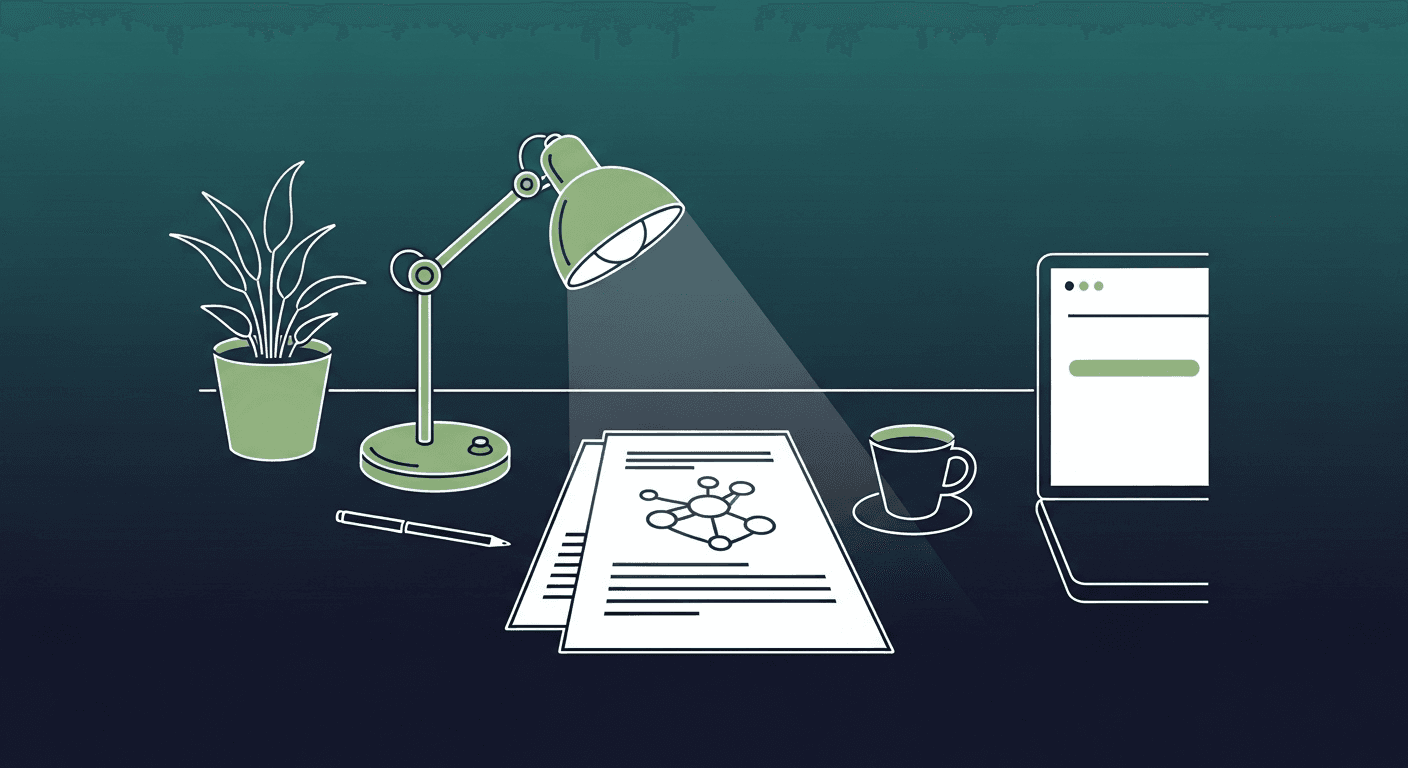
The volume of scientific literature has never been greater, and it is accelerating. In 2023, global science and engineering publication output reached approximately 3.3 million articles indexed in Scopus, a figure that has grown roughly 65% since 2010 (National Science Board, 2023). A separate analysis of Web of Science data found that indexed research studies grew 48% between 2015 and 2024. The overall growth rate of scientific publishing sits at around 4.1% annually, with a doubling time of just 17.3 years (Hoppe et al., 2022).
For a PhD student or postdoc, this has a concrete implication: staying current with the literature is not a matter of reading more efficiently. The volume problem is structural, and it requires a structural response.
The real problem is filtering, not reading speed
Most advice about keeping up with research focuses on reading habits: skim abstracts, read conclusions first, use timed work intervals. Useful tactics, but they address the wrong bottleneck. The real challenge is what happens before any paper is opened.
A 2024 study in Quantitative Science Studies, "The strain on scientific publishing," documented how the explosion in publication output has placed genuine burdens on the research ecosystem, including the bibliographic monitoring that researchers are expected to perform routinely (Hanson et al., 2024). The practical consequence is straightforward: researchers who try to read everything burn out, while those who disengage fall behind. Neither works long-term.
The solution begins upstream, at the point of discovery. Narrowly targeted keyword alerts on Google Scholar, PubMed, or arXiv can dramatically reduce the number of incoming papers worth considering. The tighter the query, the higher the signal-to-noise ratio. Broad topic alerts generate noise that itself requires cognitive work to process. Specific alerts tied directly to active research questions generate actionable leads.
Build a three-tier reading system
Not every paper deserves the same depth of engagement. Treating each one as equally important is a primary driver of literature fatigue. A tiered reading approach formalizes what experienced researchers already do intuitively.
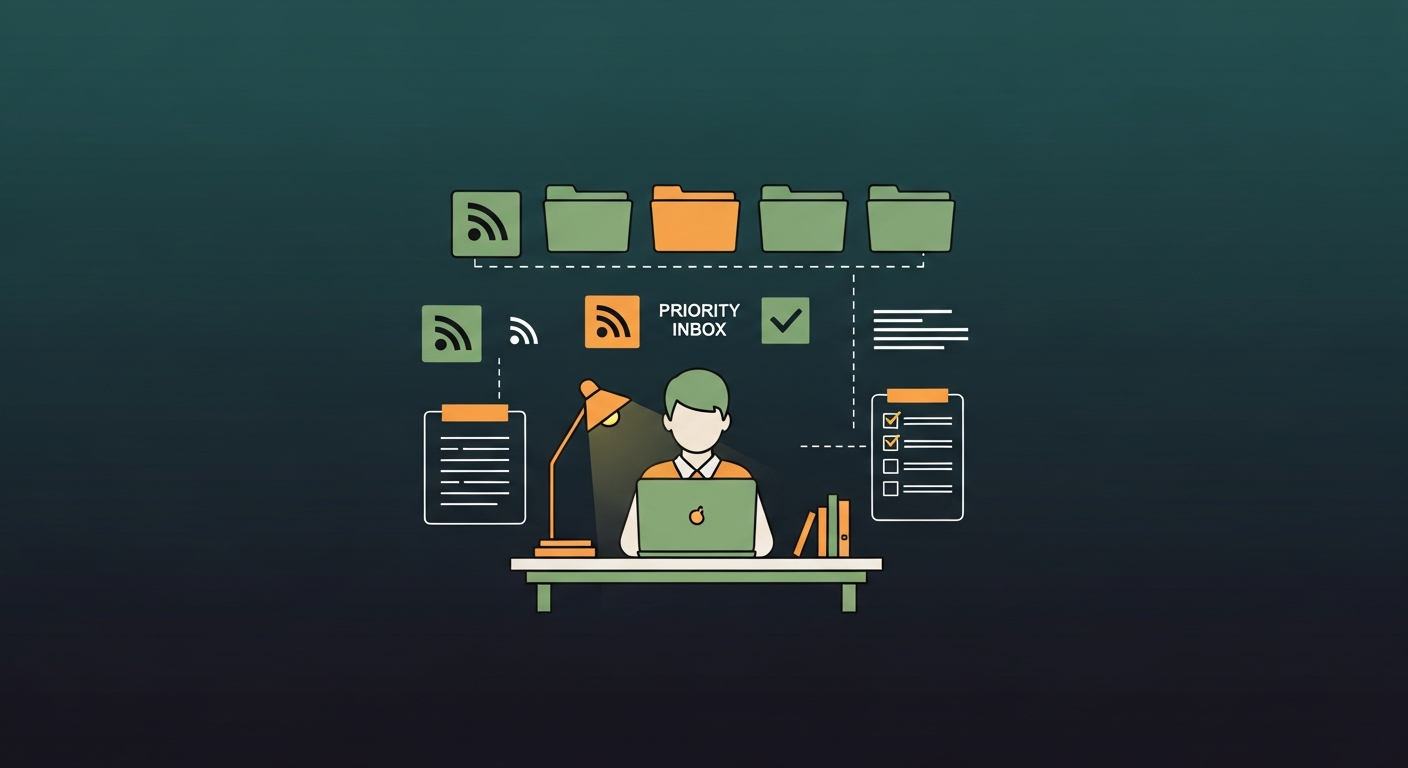
The first tier is rapid triage: scanning titles and abstracts from alerts and new journal issues once per week. The goal at this stage is not comprehension but classification. Any paper that does not directly connect to an active research question goes to an archive or a "save for later" folder, not the reading queue.
The second tier covers papers that survive triage. For these, the most efficient path is to go directly to the figures and discussion section. Most empirical papers communicate their core finding visually, and the discussion contextualizes it. If the figures are relevant, the methods section follows. If not, set the paper aside without guilt.
The third tier is reserved for a small number of papers: those that will be cited, those that challenge core assumptions in an ongoing project, or those introducing a method that requires full comprehension. This deep read, with annotation and note-taking, should represent perhaps 10 to 15% of papers that enter the inbox, not the majority.
The discipline here lies in enforcing tier boundaries. The urge to do a full read on every paper that looks interesting is both natural and counterproductive.
Let automation handle the discovery layer
Even well-designed alert systems require ongoing maintenance. Keywords drift as fields evolve, terminology varies across subfields, and manual database checks accumulate as a daily overhead. Each of these small decisions contributes to the decision fatigue that compounds over the length of a PhD.
This is where purpose-built tools help. LitFlo monitors the latest publications in your field and delivers a curated digest directly to your inbox, removing the need to check multiple databases or maintain complex search strings across arXiv, PubMed, and Semantic Scholar. The value is not just time saved. It is the cognitive load of discovery shifted away from the researcher entirely.
The broader principle applies beyond any specific tool: mental energy spent on logistics is energy unavailable for reading, synthesis, and writing. Automating discovery is a deliberate allocation of finite cognitive resources toward the work that actually advances research.
Protect reading time as a structured, bounded activity
Even with good filtering and automated discovery in place, literature review tends to drift into a reactive pattern: reading papers as they arrive, saving everything to a folder that grows but is never revisited, or context-switching mid-experiment. The cumulative effect is a persistent background anxiety about being behind.
A Nature survey of 6,320 PhD students found that 36% had sought help for anxiety or depression related to their doctoral studies, with a pervasive sense of incompleteness among the most commonly cited stressors (Woolston, 2019). Literature overload contributes directly to that sense.
Scheduling reading as a fixed, time-bounded activity addresses this at the level of habit. A dedicated two-hour block per week for literature review transforms a diffuse, always-present obligation into a concrete, completable task. When the block ends, it ends. The scientific literature is not a finite object that can be fully consumed, and drawing a clear boundary around reading time is not negligence. It is what sustainable research practice looks like.
The goal has never been to read everything published in a field. It has always been to read the right things, at the right depth, on a schedule that can be maintained for the length of a PhD and beyond.
Try LitFlo free at litflo.ai
References
- Hanson, M. A., Barreiro, P. G., Crosetto, P., & Brockington, D. (2024). The strain on scientific publishing. Quantitative Science Studies. https://doi.org/10.48550/arXiv.2309.15884
- Hoppe, T. A., et al. (2022). Growth rates of modern science: a latent piecewise growth curve approach to model publication numbers from established and new literature databases. Humanities and Social Sciences Communications, 9, 8. https://doi.org/10.1057/s41599-021-00903-w
- National Science Board (2023). Publication output: U.S. trends and international comparisons. National Center for Science and Engineering Statistics. https://ncses.nsf.gov/pubs/nsb202333
- Woolston, C. (2019). PhDs: the tortuous truth. Nature, 575, 403-406. https://doi.org/10.1038/d41586-019-03489-1
Try LitFlo
Stay on top of your field automatically
LitFlo monitors the latest papers in your research area and delivers a personalised digest — so you never miss what matters.
Get started free →Recent posts