Blog/How to Keep Up With Research Papers Without Drowning
keep up with research papers
How to Keep Up With Research Papers Without Drowning
June 29, 2026·4 min read
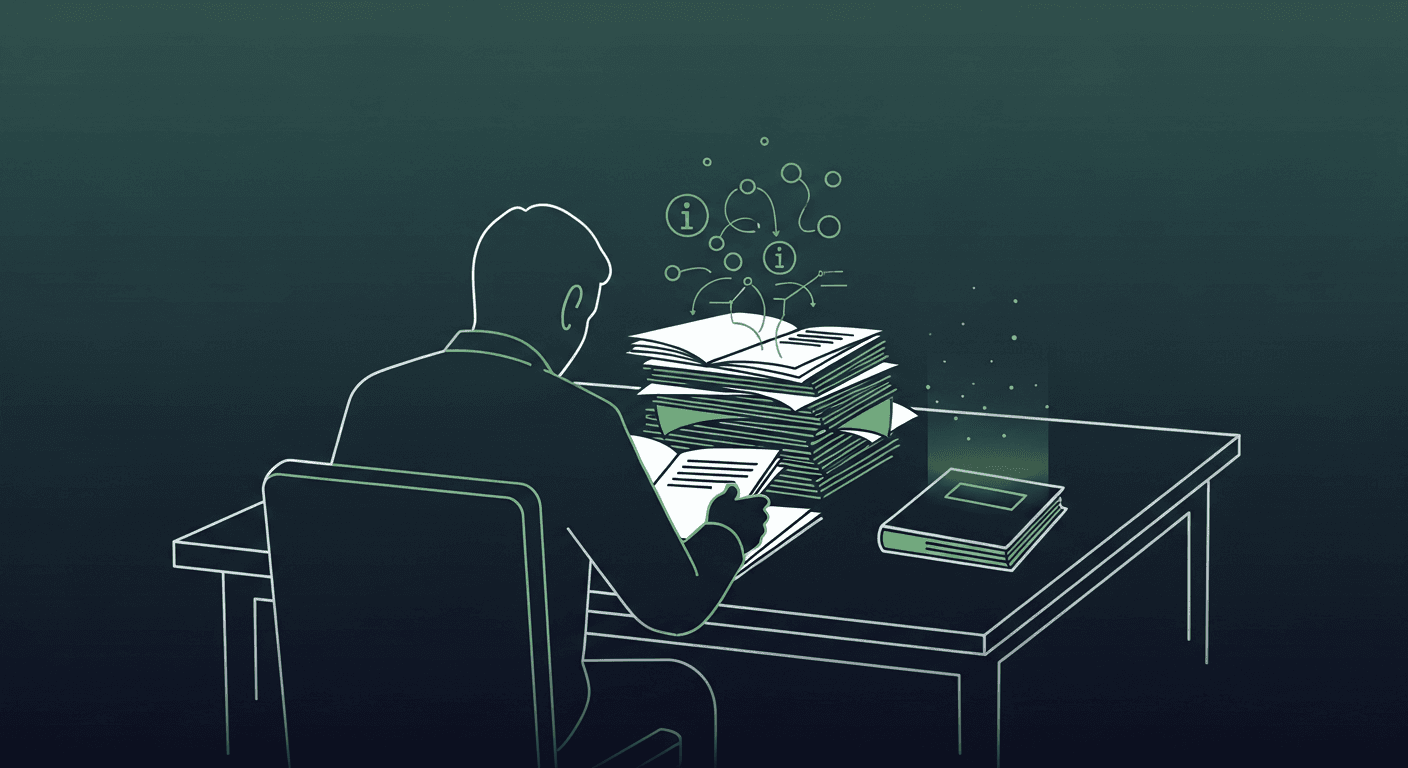
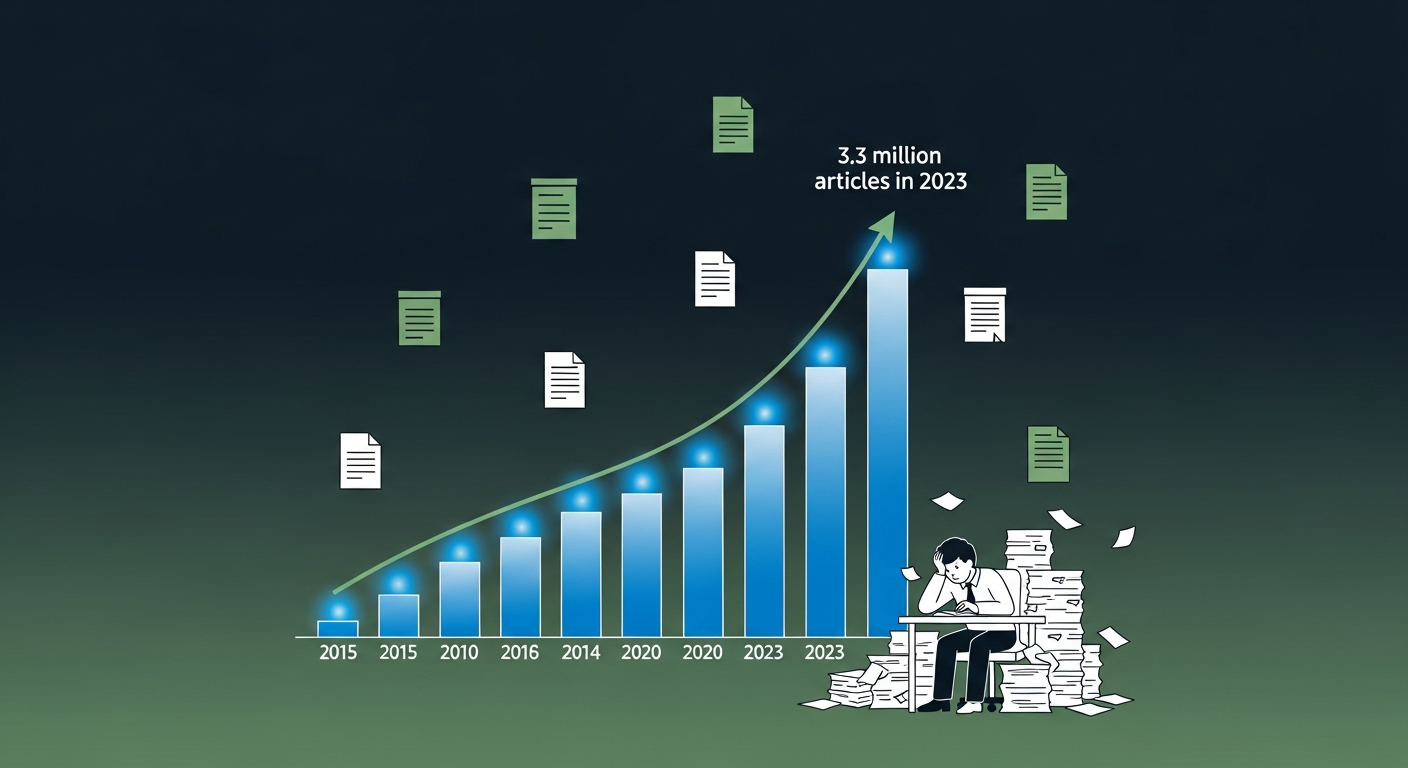
The volume of academic literature is not a minor inconvenience. It is a structural problem. Global science and engineering publication output reached approximately 3.3 million articles in 2023, and that figure has grown roughly 48% since 2015 (Clarivate, Web of Science analysis, 2025). In the natural sciences alone, over 4,000 primary research papers are published every single day (Nature, 2017). No researcher can read all of it. The question is not whether to filter. It is how to filter well.
Most guides on this topic focus on organising papers you have already found: which reference manager to use, how to colour-code highlights in Zotero, whether Notion beats a spreadsheet for reading notes. Useful, but it addresses the wrong bottleneck. The harder problem is upstream. How do you build a discovery system that surfaces the papers that actually matter to your work, without requiring four hours of weekly searching just to stay current? (Elsevier and Sense About Science survey, 2019)
The limits of traditional monitoring methods
The standard toolkit -- journal table-of-contents alerts, Google Scholar keyword notifications, PubMed RSS feeds, and Twitter -- has real limitations. Each channel delivers a fragment of the relevant literature, and collectively they create what Stanford's Lane Medical Library describes as a firehose pointed at your face (Stanford Medicine, 2018). Managing multiple alert streams is itself a time cost. And the approach is passive: you receive whatever a keyword matches, rather than what is genuinely relevant to your research questions.
Social media introduces a different distortion. Following journals or researchers on X (formerly Twitter) can yield useful signals, but the feed is self-selecting. You see what people you already follow choose to share, which tends to reinforce existing networks rather than surface unexpected findings in adjacent areas. As scientists interviewed by Science AAAS noted, there will always be "I can't believe I missed this paper" moments, but the papers that truly matter tend to find their way to you eventually -- through conferences, collaborators, or citation trails (Science/AAAS, 2016). The goal is not omniscience. It is strategic coverage.
Triage first, read second
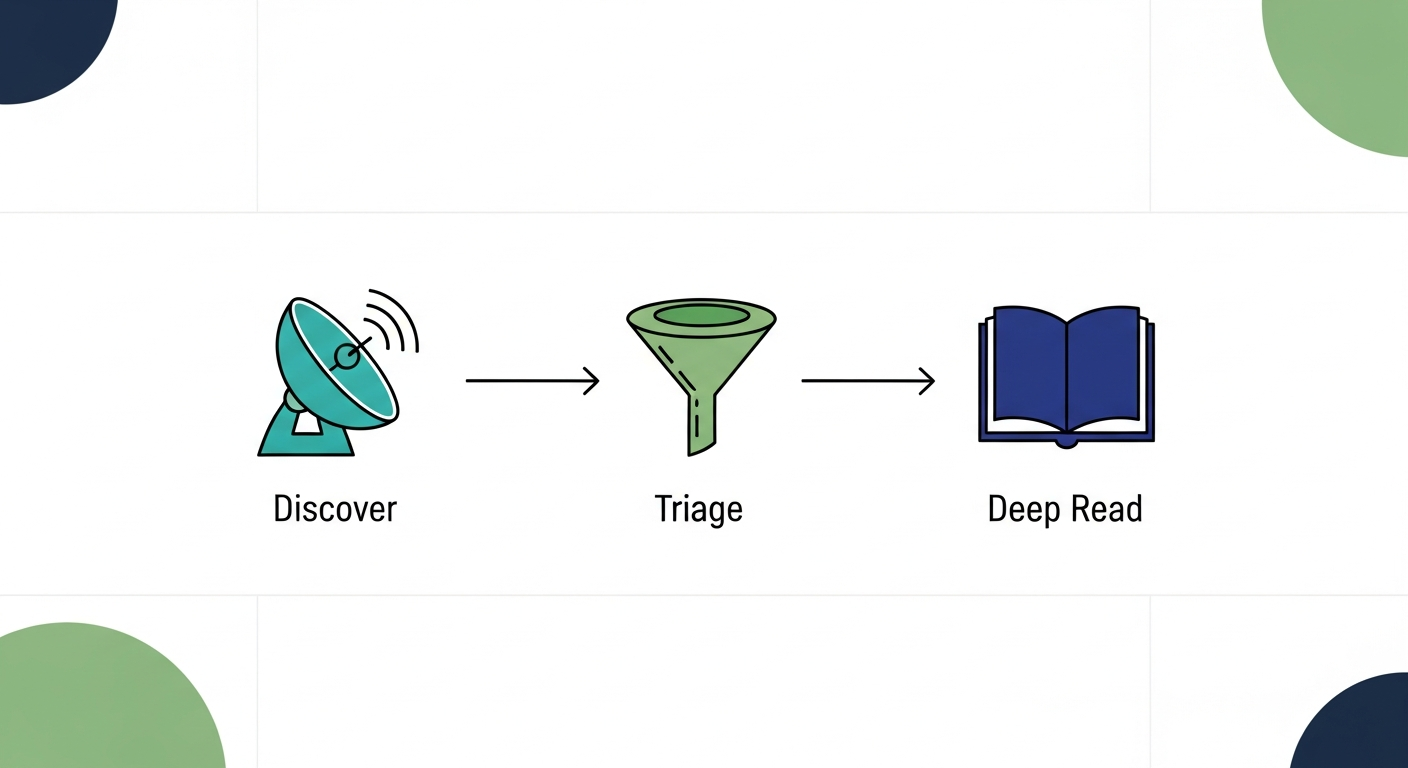
Research consistently shows that academics read between 150 and 400 papers per year (Tenopir et al., 2009-2019, cited in Morales et al., 2021). That number is far smaller than the literature available to them. Successful researchers cope not by reading more, but by triaging more efficiently. A practical triage system works in three passes.
Pass one: title and source. Dismiss anything outside your current research questions. If the paper does not speak to a problem you are actively working on or monitoring, skip it without guilt. Senior scientists at Science explicitly endorse this: prioritise papers directly related to your own projects first, top-journal frontier work second, and adjacent-field reading only when time allows (Science/AAAS, 2016).
Pass two: abstract and figures. For papers that survive pass one, read the abstract and skim the figures. This gives you the core contribution and methodology in under five minutes. If a paper merits deeper engagement, it earns a slot in your reading schedule. If not, save the metadata to your reference manager and move on.
Pass three: full read with annotation. Reserve this for a small number of papers per week -- those directly relevant to an active project, those that challenge your assumptions, or those you are likely to cite. Annotating as you read, with methods in one colour, findings in another, and open questions flagged, makes the investment compound over time.
Build a personalised discovery layer
The triage system only works if the papers entering it are already reasonably relevant. This requires investing once in a curated discovery setup rather than relying on broad keyword alerts indefinitely.
Citation-graph tools such as ResearchRabbit and Connected Papers let you map the literature around a seed set of papers in your field, surfacing both foundational work and recent citations you may have missed. Semantic Scholar goes further, ranking results by relevance to your existing reading history rather than raw keyword frequency.
For ongoing monitoring -- the inbox problem rather than the mapping problem -- personalised digest tools have become increasingly practical. LitFlo monitors new papers across your research area and delivers a curated digest to your inbox, cutting the daily scanning burden without requiring you to manage multiple alert feeds yourself. The goal is the same as a good news briefing: you get what is relevant, not everything that exists.
Collaboration is underrated as a discovery mechanism. A group of researchers covering adjacent branches of the literature collectively reads far more than any individual can. A ten-minute weekly lab meeting slot dedicated to "what did you read this week?" can dramatically extend your effective coverage.
Make the habit stick
The literature-reading habit fails most often not because researchers lack discipline, but because the system creates friction. An inbox flooded with 200 keyword-alert emails per day trains you to ignore it. A reading list that grows faster than you can clear it produces anxiety rather than progress.
Keep the entry point narrow. Follow a small number of high-signal sources -- two or three key journals, a handful of authors at the frontier of your specific subfield, and one curated digest -- rather than attempting comprehensive coverage. Accept that you will miss papers. Every researcher working at scale misses papers. What matters is that the papers most relevant to your active research reach you reliably, and that you have a consistent, low-friction habit for processing them when they do.
The researchers who stay current are not the ones who read the most. They are the ones who built the best filter.
Try LitFlo free at litflo.ai -- a personalised research paper digest that monitors the latest work in your field and delivers it straight to your inbox.
References
- National Science Board / NCSES. Publication Output by Region, Country, or Economy and by Scientific Field. NSB-2023-33. https://ncses.nsf.gov/pubs/nsb202333/publication-output-by-region-country-or-economy-and-by-scientific-field
- Booketic. Number of Academic Papers Published per Year [2026]. https://booketic.com/number-of-academic-papers-published-per-year/
- Nature Communities Blog. Keeping up-to-date with the primary literature just got a little easier. (2017). http://blogs.nature.com/ofschemesandmemes/2017/02/23/keeping-up-to-date-with-the-primary-literature-just-got-a-little-easier
- Elsevier and Sense About Science. Trust in Research Survey. (2019). https://www.elsevier.com/connect/trust-in-research
- Stanford Medicine. Scientific literature overload: Tips for staying on top. (2018). https://med.stanford.edu/news/insights/2018/08/scientific-literature-overload-tips-for-staying-on-top.html
- Science/AAAS. How to keep up with the scientific literature. (2016). https://www.science.org/content/article/how-keep-scientific-literature
- Tenopir, C. et al. Seeking, Reading, and Use of Scholarly Articles: An International Study of Perceptions and Behavior of Researchers. (2009-2019), cited via ResearchGate. https://www.researchgate.net/figure/Time-spent-reading-per-article-by-age-group_tbl5_331603778
Try LitFlo
Stay on top of your field automatically
LitFlo monitors the latest papers in your research area and delivers a personalised digest — so you never miss what matters.
Get started free →Recent posts