Blog/LitFlo vs Google Scholar: What's the Difference?
LitFlo vs Google Scholar
LitFlo vs Google Scholar: What's the Difference?
June 3, 2026·4 min read
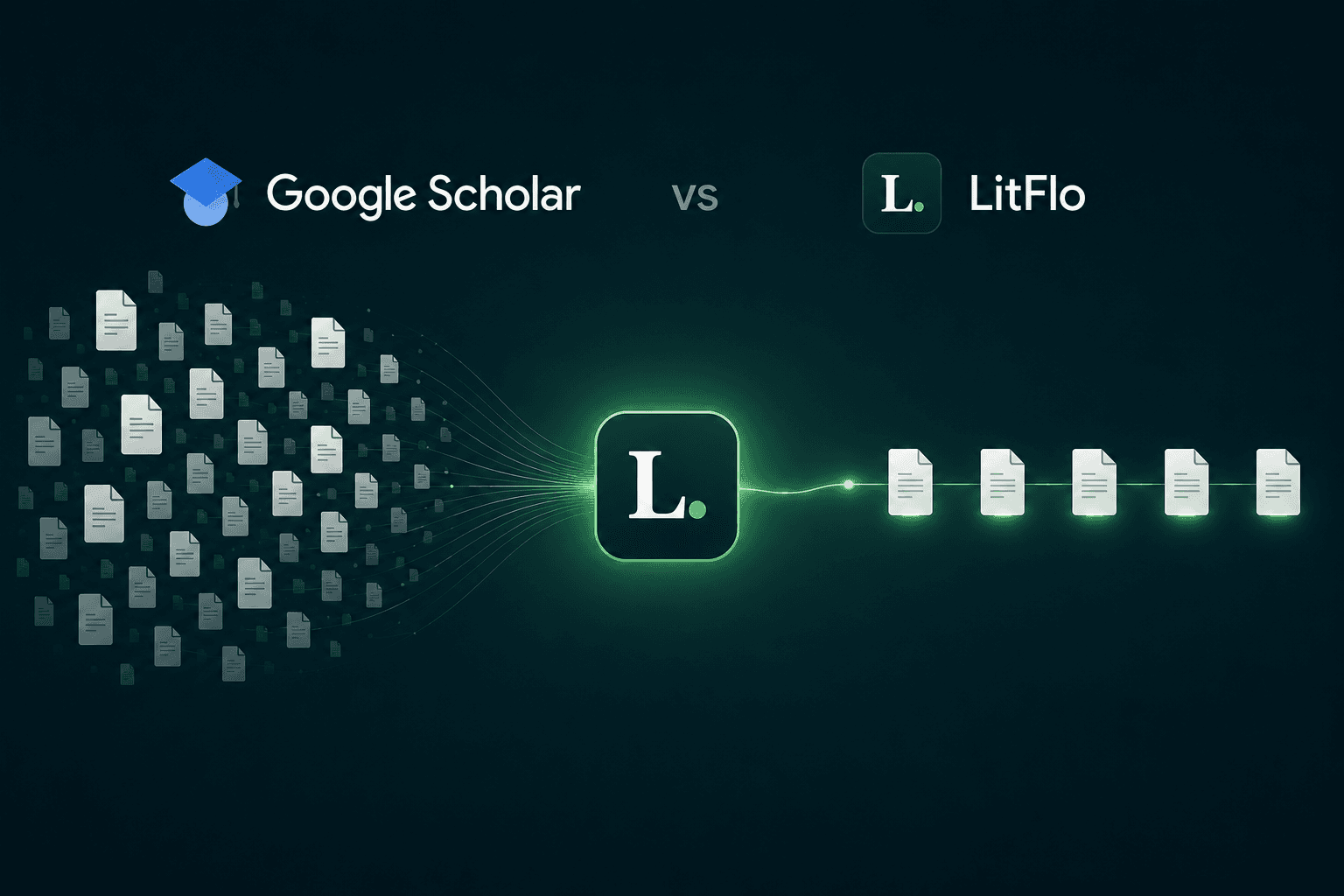
If you've spent any time in academia, you know the Google Scholar routine. You open a tab, type in a few keywords, scan the top results, click 'Cited by' a few times, and close the tab forty minutes later with seventeen papers open and a nagging sense you've missed something important.
Google Scholar is genuinely excellent at what it does. But what it does is not the same as what LitFlo does, and understanding that distinction can save you a lot of wasted effort.
Google Scholar is a search engine. A very good one.
Launched in 2004, Google Scholar quickly became the default starting point for academic literature. It indexes close to 400 million documents spanning peer-reviewed articles, conference papers, preprints, theses, and books across virtually every discipline. Its citation tracking lets you trace how a paper has been used, follow intellectual threads forward and backward in time, and build a rough map of a field's architecture.
Its strength is breadth. Unlike many databases that index only titles and abstracts, Google Scholar's algorithm extends into full-text content, which means it can surface niche mentions of specific terms that more curated databases would miss. Starting a literature review from scratch? Need to track down a paper you half-remember from a seminar two years ago? Google Scholar is the right tool.
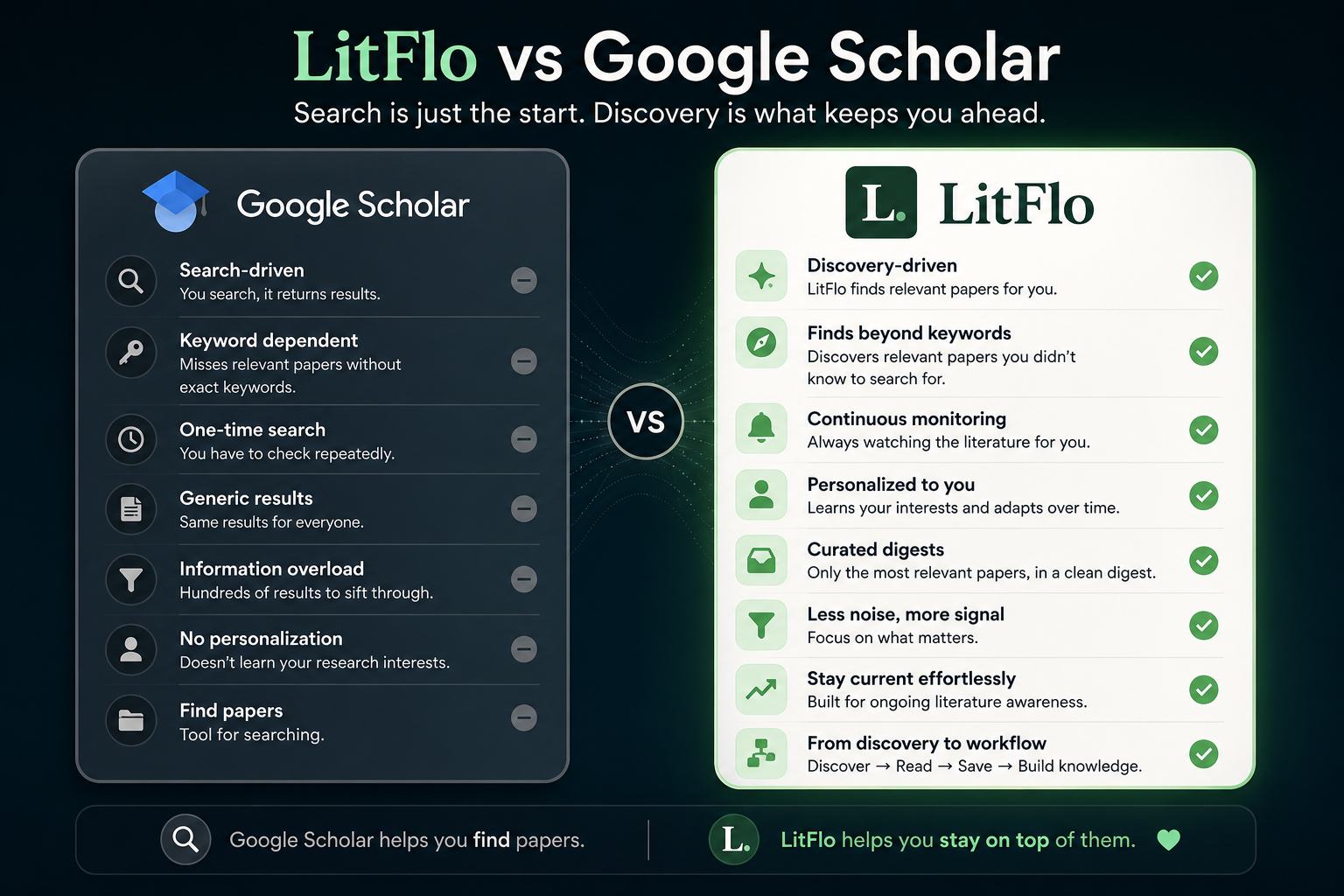
The word to hold onto, though, is "search." Google Scholar is reactive. You go to it. You type something in. It responds. Then you close the tab and get back to your thesis.
The problem with reactive searching
Global scientific publication output grows at roughly 4% per year, and the total volume indexed in Scopus and Web of Science was approximately 47% higher in 2022 than it was in 2016, outpacing the growth in the number of practicing scientists. In practical terms, the literature in your subfield is moving faster than any periodic searching habit can keep up with.
Google Scholar does offer Alerts, which are keyword-based email notifications when new papers match your search terms. But keyword alerts have a fundamental limitation: they require you to know in advance exactly what you are looking for. A paper that reframes a core assumption in your field, uses slightly different terminology, or sits at an interdisciplinary boundary will slip right through. Google Scholar has no mechanism for learning from your reading behavior, narrowing recommendations over time, or surfacing foundational work you might have missed earlier in your PhD.
The result is a pattern most researchers will recognize. Periodic bursts of intense literature searching followed by long gaps, and a persistent background anxiety that something important has been published that you have not seen yet.
What LitFlo does differently
LitFlo is not a search engine. It is a monitoring service, which is a fundamentally different thing.
Rather than waiting for you to come to it, LitFlo fetches the latest research papers in your field and sends them straight to your inbox, covering both recent work and foundational classics. As you rate papers, its model learns your preferences, so the digest becomes more precise over time. You are not entering keywords. You are training a system to understand what kind of research actually matters to your work.
This addresses a gap that Google Scholar, by design, cannot fill. Search engines are tools for retrieval. They answer questions you have already thought to ask. A digest service is a tool for discovery. It surfaces relevant work you would not have thought to search for. These two use cases are genuinely distinct, and expecting Google Scholar to do both leads to frustration.
The distinction matters most in the middle of a PhD. In the early stages, broad searches map the field. In the final year, you are writing. But in the long middle period, when you are actively producing research and need to stay current without spending hours a week on PubMed, a personalised digest fills a gap that a search engine cannot.
Which one do you actually need?
Both, but for different jobs.
Use Google Scholar when you have a specific retrieval task: tracking a citation thread, searching for methodological precedents, or checking whether a specific claim has prior literature behind it. Its coverage and citation network tools remain unmatched for targeted retrieval.
Use LitFlo when you need to stay current without actively searching. Because scientific publication volume is growing at over 5% per year with no sign of slowing, maintaining field awareness through periodic manual searches is increasingly impractical. The researchers who stay genuinely current are not the ones with the best Google Scholar habits. They are the ones who have built systems that bring the literature to them.
Try LitFlo free at litflo.ai.
References
- Hanson, M.A., et al. (2023). The strain on scientific publishing. Quantitative Science Studies, 5(4), 823-843. https://doi.org/10.1162/qss_a_00327
- Moral-Munoz, J.A., et al. (2021). Growth rates of modern science: a latent piecewise growth curve approach to model publication numbers from established and new literature databases. Humanities and Social Sciences Communications, 8, 224. https://doi.org/10.1057/s41599-021-00903-w
- National Center for Science and Engineering Statistics. (2020). Publications Output: U.S. Trends and International Comparisons (NSB-2020-6). National Science Foundation. https://ncses.nsf.gov/pubs/nsb20206
- Paperpal. (2026). Top 5 Google Scholar Alternatives in 2026 (Reviewed). https://paperpal.com/blog/news-updates/google-scholar-alternatives-tested-reviewed
- Singapore Management University Libraries. (2024). Google Scholar vs. AI Academic Search: Expanding the literature review toolkit. https://library.smu.edu.sg/topics-insights/google-scholar-vs-ai-academic-search-expanding-literature-review-toolkit
Try LitFlo
Stay on top of your field automatically
LitFlo monitors the latest papers in your research area and delivers a personalised digest — so you never miss what matters.
Get started free →Recent posts